How AI Is Changing the Way Humans Interact
Artificial Intelligence, or AI, is no longer just a technology of the future. It is already part of our everyday lives. We use AI to search for information, write messages, translate languages, learn new things, create content, and even have conversations.
But AI is doing more than making our lives easier. It is changing the way humans communicate, work, learn, and connect with each other.
From Talking to People to Talking to Machines
In the past, if we had a question, we would ask a teacher, friend, or expert. Today, we can simply ask an AI tool and get an answer within seconds.
For example, a student struggling with mathematics can ask AI to explain a difficult problem step by step. Someone learning a new language can use AI to practice conversations. A professional can ask AI to help write an email or summarize a long document.
AI has become more than a tool we operate. It has become something we can interact with.
AI Is Changing Human Communication
AI is also changing how we communicate with other people.
People use AI to write emails, social media posts, applications, and even personal messages. Translation tools can help someone in India communicate with a person in France, Japan, or Brazil without knowing their language.
For example, someone who is not confident in English can use AI to turn their thoughts into a clear and professional message.
This is helpful, but it also raises an important question:
If AI writes our words, are we still expressing ourselves?
AI can improve our communication, but our emotions, experiences, and personal voice are what make communication truly human.
AI and Human Relationships
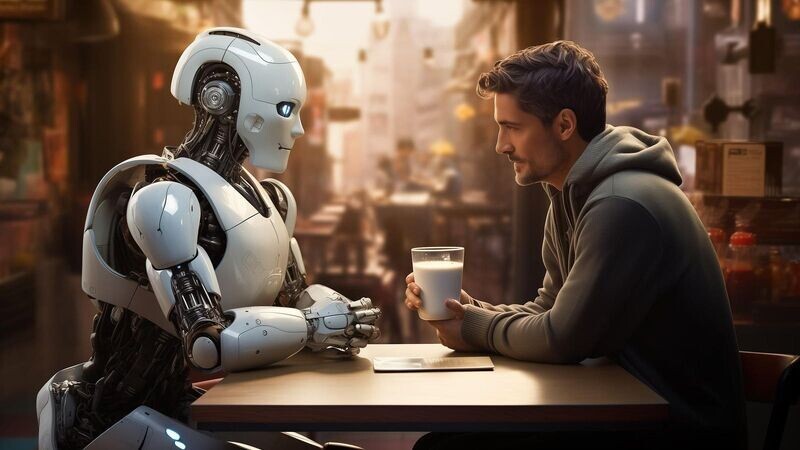
One of the biggest changes is that people can now have conversations with AI whenever they want.
For example, a person can use an AI chatbot to practice an interview, discuss an idea, or simply have a conversation when they need someone to talk to.
This can be useful, especially when people need quick support or do not know where to begin. But AI should not become a replacement for real human relationships.
A machine can respond to our words, but friendship involves emotions, shared experiences, trust, and genuine connection.
AI can imitate conversation, but it cannot replace human connection.
AI at Work and in Education
AI is also changing workplaces and classrooms.
For example, a marketing employee can use AI to generate ideas for a campaign, while a teacher can use it to create practice questions for students. A doctor may use AI-assisted systems to help analyze medical information, while a programmer can use AI to help identify errors in code.
These tools can save time and allow people to focus more on creativity, decision-making, and problem-solving.
However, depending too heavily on AI can also become a problem. If students use AI to complete every assignment instead of learning themselves, or employees stop developing their own skills because AI does everything for them, technology can become a limitation rather than an advantage.
The Social Media Effect
AI is also quietly influencing what we see online.
Social media platforms use algorithms to recommend videos, posts, news, and advertisements based on our interests and behavior.
For example, if you repeatedly watch videos about fitness, an AI-powered recommendation system may show you more fitness content.
This makes social media more personalized, but it can also mean that people see mostly content that matches what they already believe or enjoy.
In this way, AI does not just influence what we do online—it can influence what we pay attention to.
The Real Challenge
AI itself is neither simply good nor bad for society. Its impact depends largely on how we use it.
Used wisely, AI can help people learn faster, communicate across languages, save time, and connect across distances.
Used carelessly, it could make communication less personal and encourage people to depend too much on technology.
The real question is not:
“Will AI replace humans?”
It is:
“How can humans use AI without losing what makes us human?”
Conclusion
AI is changing the way we talk, work, learn, and connect. From helping students understand difficult subjects to helping people communicate across languages, its influence can already be seen in everyday life.
But as AI becomes more powerful, we should remember that technology is a tool—not a replacement for human relationships.
The future may have smarter machines, faster communication, and more advanced technology. But qualities such as empathy, trust, creativity, friendship, and compassion will remain uniquely important.
AI may change the way we interact, but we should make sure it never changes what it means to be human.